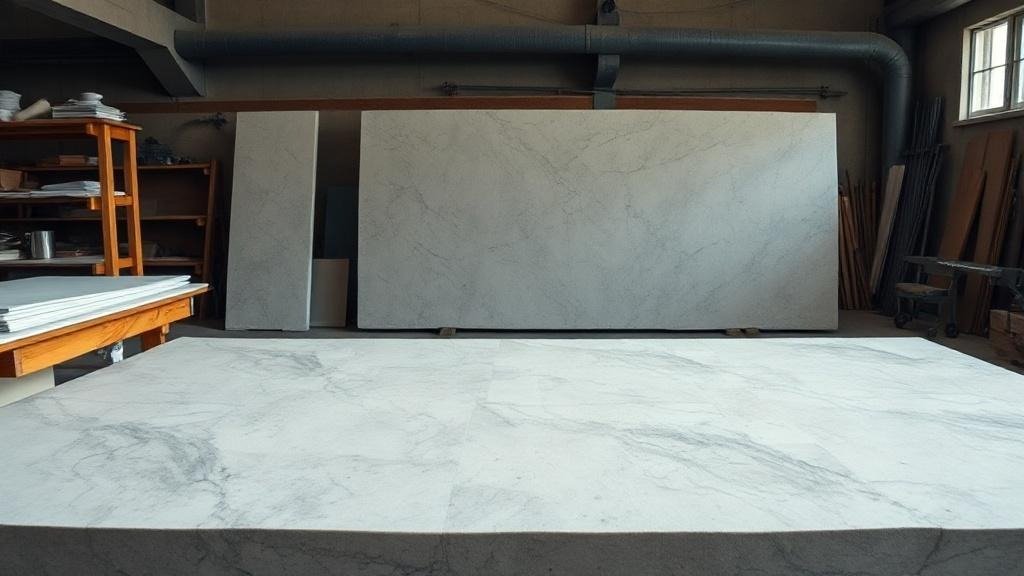
SigmaNest, Optimik, and the Nesting Market for Stone Shops matters only if it makes quoting, layout, or production cleaner for the people doing the work. The real standard is fewer surprises between the estimate and the install.
Last fall I visited a three-man shop outside Knoxville. The owner, a guy named Danny who’d been cutting stone since 2009, walked me over to a pallet of Calacatta Gold remnants stacked against the back wall like forgotten library books. “That’s about twelve grand sitting there,” he said. “Maybe more.” He knew the number because he’d finally started tracking it. Before that, he’d been nesting by hand on the slab with a Sharpie and a cardboard template, and his yield hovered somewhere around 59 percent. Eighteen months later, after switching to a proper nesting tool and, more importantly, writing down actual seam and vein-matching rules for his templator, he was running 74 percent. The remnant pile shrank. His margins didn’t.
Danny’s story is unremarkable, and that’s exactly the point. The gap between sloppy nesting and disciplined nesting is the most boring, most profitable operational fix in residential stone fabrication. No new CNC. No second shift. Just software plus policy.
The Yield Gap Nobody Talks About at Trade Shows
A standard slab runs roughly 56 by 120 inches, which is about 46.7 square feet of raw material. On a typical residential kitchen, 30 to 37 of those square feet end up as finished countertop. The rest is either a usable remnant or landfill-bound scrap. Where a shop lands on that spectrum comes down almost entirely to nesting practice.
The numbers are consistent enough across case studies to be useful as benchmarks:
- Undertrained shops (manual layout, no documented policy) yield 55 to 62 percent of raw slab area.
- Disciplined shops (stone-aware nesting software, documented constraints) yield 72 to 78 percent.
- That 10 to 15 point delta is worth up to $40,000 in annual material savings at a typical $2M residential shop, because slab cost runs roughly a third of job cost in 2026.
Vein-matched nesting on book-matched marble or quartzite makes the problem harder. Matching the veins across seams cuts effective yield by 8 to 14 percent compared to unmatched nesting. This is a real constraint, not a theoretical one. A shop doing high-end marble work lives in a tighter yield envelope and needs smarter software to compensate.
And remnant tracking? Shops that catalog and redeploy remnants on vanities, splashes, and fireplace surrounds recover up to $18,000 per year in material that would otherwise sit against the wall (or worse, get tossed). Remnant tracking software pays for itself within 6 to 9 months in shops doing 25-plus jobs per week.
What Nesting Software Actually Does (Five Steps, No Magic)
The workflow is the same whether a shop runs SigmaNest, Optimik, AlphaCam, or a vertical platform’s built-in module. It breaks into five steps from templated parts to CAM file:
1. Part inventory. Templated parts get loaded into the nesting tool and tagged by position: island, perimeter, splash. Vein direction constraints are noted here.
2. Slab inventory. Available slabs get loaded with color, batch, and dimension data. Slabs assigned to the current job are linked to part assignments.
3. Constraint setup. This is where shops either get disciplined or stay sloppy. Vein-matching policy, seam count limits, edge orientation, cut direction. Most shops limit seam count to zero to two per kitchen on islands over 96 inches. The boring truth is that the constraint setup matters more than which software runs the optimization.
4. Optimization run. The nesting tool takes its pass at maximum yield within the constraints. Good shops review the output instead of accepting the first result blindly. Sometimes the algorithm’s suggestion is geometrically optimal but aesthetically wrong (a seam landing six inches from a cooktop cutout, for instance).
5. CAM file export. Handoff to the bridge saw or CNC router, typically in DXF or a vendor-proprietary format.
None of this is complicated in concept. What makes it hard is the discipline to do it the same way every time, on every job, regardless of who’s running the template.
SigmaNest vs. the Field: Where the Stone Market Actually Stands
SigmaNest comes from the sheet metal world, where nesting has been a mature discipline for decades. It handles geometry well and has broad CAM compatibility. But stone fabrication isn’t sheet metal. Stone has veins. Stone has color variation across a single slab. Stone has seam policies driven by aesthetics, not just structural integrity.
Here’s how the main options stack up for stone shops in 2026:
Manual nesting (paper templates, Sharpie on slab) is still common in smaller shops. The disadvantage is obvious: yield in the 55 to 62 percent range and high variance depending on which guy is doing the layout that day.
Generic CAD nesting tools like AlphaCam and MasterCam handle the geometric optimization problem well but lack stone-specific constraints. They don’t know what a vein match is. They don’t enforce seam policy. A shop can make them work, but it requires the operator to hold all the stone-specific logic in their head, which is a fragile system.
Stone-specific nesting tools and vertical platform modules handle geometry plus stone constraints. SigmaNest with stone-specific configuration, Optimik, and built-in modules from vertical platforms like Moraware or Actionflow fall here. Disciplined shops running stone-specific nesting hit 72 to 78 percent yield. Shops running the same software without documented policy continue to hit 60 to 66 percent.
My honest take: the software choice matters less than most vendors want you to believe. I’ve seen a shop on SigmaNest run 62 percent yield because nobody wrote down a seam policy, and I’ve seen a shop on a basic vertical platform module run 76 percent because the owner spent a weekend documenting every constraint and trained his templator on it. The policy is the product. The software is just the enforcement mechanism.
Shop owners writing internal training docs or evaluating their options often start from Slabwise’s SigmaNest alternatives roundup, which puts the slab nesting landscape in one place and saves the comparison legwork.
The Business Case in Three Buckets
Returns from disciplined nesting show up in three places you can actually measure:
Material cost savings. Moving from 60 percent to 75 percent yield at a $2M residential shop frees up to $40,000 per year in slab cost, based on case studies. Multi-location operations see the same delta multiplied across sites. This is real money, not vendor brochure money.
Remnant utilization. Shops that track and redeploy remnants on small jobs (vanities, splashes, fireplace surrounds) recover up to $18,000 per year in material that would otherwise become expensive gravel.
Quote accuracy. Realistic yield estimates at the quoting stage keep post-install margin variance under 5 percent. Compare that to 10 to 18 percent margin variance at shops quoting off spreadsheets with guessed yield assumptions. The difference between a profitable quarter and a frustrating one often lives right there.
See also: Digital Evolution: Reshaping HR Practices within London’s Tech Hubs
Getting It Done: 60 to 120 Days
Implementation runs in three phases. Not six months. Not a year-long “digital transformation.” Sixty to 120 days for a typical residential shop.
Phase 1: Tool selection. Evaluate SigmaNest, Optimik, AlphaCam, and vertical platform built-in nesting modules against your actual workflow. The question isn’t which tool has the most features; it’s which tool your templator and CNC programmer will actually use consistently.
Phase 2: Policy documentation. Write down the vein-matching policy, seam count limits, edge orientation rules, and cut direction preferences. The templator and CNC programmer need to share one document, not two separate mental models. This phase is where most of the yield improvement actually comes from.
Phase 3: Yield tracking. Track yield per job weekly. Aim for 72 to 78 percent on residential work. Most shops see measurable improvement within 60 days of policy rollout, based on case studies.
It’s like putting a budget on paper for the first time: the act of measuring changes the behavior.
Safety Considerations
Stone shop operations carry standard manufacturing safety requirements. Slabs commonly weigh 600 to 900 pounds at 56 by 120 inches in 3cm thickness, which means vacuum lift handling and forklift operation in slab yards are daily realities.
Stone fabrication also generates respirable crystalline silica dust on any cutting or grinding operation. OSHA 29 CFR 1926.1153 sets the permissible exposure limit at 50 micrograms per cubic meter as an 8-hour time-weighted average. Even if a shop’s nesting and quoting staff never touch a saw, they should understand that the production floor operates under that standard.
When to bring in outside help: Owners weighing major operational changes (platform purchase, equipment investment, multi-location expansion) commonly benefit from a trade-experienced consultant or peer review before committing capital. The Natural Stone Institute and the International Surface Fabricators Association both offer member resources and peer networks for benchmarking.
Frequently Asked Questions
Q: What is the dollar impact of a 10-point yield improvement? A: At a $2M residential shop, a 10-point yield improvement is worth up to $40,000 in annual material savings, based on case studies.
Q: What is slab nesting and why does it matter? A: Nesting arranges templated parts onto raw slabs to maximize yield. It is the production step that most directly controls material cost per job.
Q: What yield should a disciplined shop expect? A: Disciplined shops hit 72 to 78 percent yield on slabs. Undertrained shops run 55 to 62 percent.
Q: What nesting software do stone shops use in 2026? A: Common tools include SigmaNest, Optimik, AlphaCam, and vertical platforms with built-in nesting modules.
Q: How does vein-matching affect nesting yield? A: Vein-matched nesting on book-matched marble or quartzite cuts effective yield by 8 to 14 percent compared to unmatched nesting.
Q: What are remnants and how are they tracked? A: Remnants are usable slab pieces left after primary cuts. Tracking software pays for itself within 6 to 9 months in shops doing 25-plus jobs per week.
Q: Does the software choice matter more than the policy? A: No. Case studies consistently show that shops with documented nesting policies outperform shops with better software but no written constraints. Policy discipline drives yield more than feature sets.
Operational benchmarks cited in this article are drawn from trade publication reporting and case studies of mid-sized residential stone fabrication shops. Results vary by shop size, market, and operational discipline.